
I was recently talking with the dad of a teenager with an eating disorder; his pain and anguish were palpable as he tried to appear tough and matter of fact. He mentioned to me, over and over, that although he endlessly loved his daughter, he knew he couldn’t help her and he knew that this may be a lifelong battle.
We spoke for about forty minutes about his family’s history of mental illness and my own. I am always honest with my clients. Of course I curtail some of their questions when need be, but, for the most part, I answer them honestly. He asked me how long it took me to recover. I paused, thought about that question, and answered honestly. I told him that I was diagnosed at about 16 or 17 years old and consider myself to have been fully recovered at about 24 or 25. He became exasperated. “Nine years, oh dear God, we haven’t even done this for one year yet!”
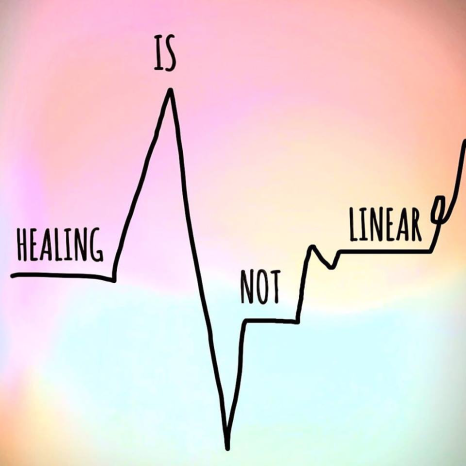
I felt horrible. In no way had I attempted to squash his miniscule amount of hope any further, but somehow I did. But here is the thing: recovery is not linear. We hear this all the time in the treatment world, but what does it truly mean? Over the course of those nine years, I was not deep in the throes of my eating disorder. I wasn’t completely stuck in the torturous dialogue with my eating disorder. I wasn’t isolated and alone. I wasn’t lashing out at my supports when they expected me to eat a fear food with them. I just wasn’t recovered. Eating disorders take time to be ingrained into someone’s daily life. They don’t just start over night, despite what you may observe. They are insidious and slowly trickle into someone’s life. Maybe they first start by telling the person they are ugly and need to lose weight in elementary school, or by encouraging them to count calories or fat grams. And slowly, over time, they begin to take over the person’s daily life. Recovery is the same gradual process but in the opposite direction.
In my experience working with clients and my own personal recovery, I believe the process often starts by decreasing and eventually eliminating eating disorder behaviors. That is where treatment often comes in. We work to help the client develop a healthy relationship with food by eating throughout the day and help them to keep their food without compensatory behaviors. We work to uncover underlying causes and explore the function of the eating disorder while rehabilitating the client’s behavior with food. We implement healthier ways of getting their needs met that do not include food, body, and appearance. When a person begins this process, they experience mental anguish as their eating disorder lashes out at them with severe urges to use eating disordered symptoms. It encourages them to ruminate regarding their lack of symptom use and perceived consequences of not doing so (losing what makes them special, weight gain, loss of identity, becoming out of control, etc). As the client works through these urges and obsessive thoughts, they begin to re-wire their thought processes, but this takes a great deal of time.
The next stage of recovery often includes incorporating newly learned skills and mentalities into daily living. This is often where lapses occur, and this stage takes the most time to master. It’s easy to stay recovery-minded in treatment, but incorporating recovery into every day life is challenging. I was told by a recovered supervisor of mine that she overcame this challenge by creating a life that was more interesting to her than her eating disorder. This was similar to my experience. I had to create a life that could not include my eating disorder. For me that was easy – becoming an eating disorder therapist. I wanted to help others more than I wanted the comfort of my eating disorder. And I knew that no matter what my eating disorder promised, I couldn’t have the life I wanted and an eating disorder. This stage is challenging because sufferers are faced with all of the triggers and events that allowed the eating disorder to thrive, but they have to consciously choose to do things differently. This is very difficult. If you have always written with your right hand, and now you have to right with your left, it would take time to master that skill. You would need practice to build the muscles and ability of your left hand. At first the handwriting would be illegible, but, as time went on, it would become clearer. This is a simplistic way of thinking about the time it takes to embrace and create a life in recovery. It doesn’t happen overnight, and it takes time to become more natural. This stage is often where symptom swapping occurs. A client will start restricting instead of bingeing and purging, or drinking heavily instead of using behaviors. Symptom swapping is usually not conscious, but it is a way to cope with the discomfort extinguishing behaviors can cause. Clients live in this stage for the longest period of time. It can take months or years as they learn to incorporate recovery into their lives and find motivators for living life without their eating disorder. It takes time to strengthen their belief in themselves to become recovered.
The next stage is where the client is committed to recovery but still battles thoughts related to the eating disorder. Most commonly, I see this with thoughts of body image. The client may desperately want to be recovered but still worries about their body and how others will perceive them if they completely let go of their eating disorder. They are completely committed to being in recovery but still struggle with some of their thoughts. Over time this stage becomes less obvious and the thoughts become less severe. Instead of feeling urges, they just notice the thoughts. Years into recovery I still had tidbits of my eating disorder that I held onto. For example, I had always chosen Diet Coke. When only regular Coke was offered, I would drink it, but I felt a strange pang of Oh, I shouldn’t do this. When I was with a friend and they wanted to eat pasta for lunch, I would hear my old eating disorder voice say, “Pasta is a dinner food only.” Those thoughts didn’t alter my behavior, but they were strange – almost like ghosts of my eating disorder. For me, these thoughts lasted for years after completely stopping behaviors.
Each of these three stages lies on a gradient of severity, and they are different for everyone. In my experience, recovery typically follows a trajectory with dips back into previous stages from time to time. The more you feel the fear and do the right thing anyway, the more you move towards recovered! Recovery is not linear, but the process does get easier over time. The sufferer will be able to gain more and more freedom from the eating disorder as they challenge it and build a life they want to live with healthy relationships, coping skills, and passions!
 Insights from a recovered eating disorder thearpist